Showing posts with label PDP Part 2. Show all posts

Thursday, 10 May 2012

MT Editorial

I recently did a small editorial illustration for this months issue of Management Today magazine. It was to illustrate the word 'Boss' from the given definitions. One definition of the word was that it was a synonym for 'superfly', hence the 70's guy on the left, and obviously a more standard office type boss getting a bit stressed on the right.

It was my first proper commission so it was a bit daunting, but it all went really smoothly and I'm fairly happy with the outcome. Check out the image below, as well as a snippet of it in the magazine layout. Cheers!


Wednesday, 9 May 2012

Draw North West Poster

I recently had the chance to design a poster for the next Draw North West meeting in May, and its now up on the site, so I though I'd do a quick post about it.

Mr Alan Dalby was my AD for the week, and we had a quick chat about the sort of stuff that could go on it, and I settled on doing an biplane design as it's loosley related to navigation and direction and links with it being in the North West. Also I thought it would be fun to do aeroplanes as its not something I've tried before! Anywho, I've poster the poster below, and also my rough.

Cheers to DNW and Alan for asking me to do it!


Sunday, 6 May 2012

Big Illustration Party Time Excellent Podcast

It was recommended that we listen to a podcast called Big Illustration Party Time, found here. The podcast is recorded by illustrators Kevin Cross and Joshua Kemble, and consists of them talking about all sort of issues associated with being a freelance illustrator. The particular episode we listened to cover lots of things to do with getting work and self promotion. 

They started off by talking about cold calling art directors. Unless I'm mistaken, they were talking about cold calling AD's to talk to them and see if it was ok to email over work, and they came to the conclusion that sending a cold email was less annoying and probably a better thing to do. I don't think I'd ever considered really phoning someone up just to ask if I could email them my portfolio, but who knows, maybe speaking to them first might actually guarantee a response to your email? On the other hand, we've always been encouraged to try and speak to someone directly when it comes to portfolio visit meetings, which I think makes more sense as its quicker to get a yes or no, and arrange times etc. 

They went on to speak about how to use email as a self promotion tool. Here are some of their tips for sending emails and compiling mailing lists:

  • Compile a list of art directors and send a first email to them all. Any that send you a reply, add to a separate mailing list to send your 'newsletter' to in the future.
  • Email every 3 months - to both 'fans' and prospective employers. 3 months gives you lots of time to come up with lots of new work.
  • Add a ''remove from mailing list' option so they can opt out if they want
  • Try using BCC for the mailing list to avoid spam filters 

It was interesting to here them talk about sending bulk emails via mailing lists, as it something we've kind of been old not to do, as it goes against the idea of personalising your correspondence. I think however that if your doing it in the for of a newsletter, its obviously accepted as standard that these won't be personal. Setting up a newsletter type email is really something to think about, as long as you do a good job, as you can embed links and images into the email so people don't have to waste time downloading and opening separate files.They recommended keeping the content short and sweet, and trying to make it look interesting with nice type etc. They also suggested sending a thank you email after a job is completed is a good thing to do as shows that you appreciated getting the work and are open to more work in the future. In contrast to the Charles Hively podcast, these guys seemed interested in the idea of sending out promo Christmas cards, although they hadn't tried it yet. On one hand, there is something a bit insincere about sending out a card that is also self promotion, but on the other hand, its seems stupid as an illustrator, if you are going to send out a card, that it wouldn't be something you've designed yourself. Maybe this would be best kept for clients you've already worked with rather than prospective clients, because....it's a bit weird anyway to send a stranger a card.

In the next part of the podcast, they spoke about social networking and portfolio sites. This was something I'd recently been involved in a discussion about, so it was interesting to hear what these guys had to say. Here are their suggestions:

  • Spend money making your own site awesome rather than paying for portfolio sites that may not be worth the money
  • Things like Illustration Friday can be good for networking and also building your portfolio quickly
  • Putting work up on sites like Flickr can be good exposure and help increase traffic to your site
  • Using social networking like twitter might not get you work directly, but can get you invites to gallery shows or exhibitions

 I definitely agree that networking and getting your work seen is so important. I'm already on a few social networking sites, but Flickr is something I'm definitely going to look into. Getting your work everywhere will definitely make your life easier and increase your odds of getting work, however I do think its good to edit where you put your work in one sense, and just stick with reputable sites and one with strong illustration communities otherwise its probably just making more work for yourself to update them. I think it's probably trail and error to find the places that work best so I'll hopefully try a few more places in the future and see how it goes. 

Finally, the guys made a point at the end of the podcast about the importance of networking and keeping in contact with other students from your course. I definitely hope to keep in contact with students from my course where possible, and work together in the future. They also recommended getting involved with whatever you can, such as groups or podcasts, and to keep yourself involved and motivated if you want to make a career out of illustration.

 
Overall, the podcast was really helpful and they had lots of good tips and advice that I can use. In contrast to the Charles Hively podcast, their advice seemed to come more from an illustrators perspective, and even contradicted some of the things Hively suggested. I think from this I can draw the conclusion that self promo isn't a science, and some types of promo will go down better with some people than with others, and it might just be a case of giving things a go and seeing how it works out.


><><><><><><><><><><><><><

Podcast: Charles Hively of 3x3

Recently, an interview with Charles Hively (from 3x3) was recommended to us in the form of a podcast on Escape From Illustration Island.

On the podcast, Charles goes through his background and experiences as a designer and illustrator, and goes on to talk about issues such as self promotion for illustrators, and how competitions can be a good way to get your work shown. 

Hively runs 3x3 magazine which is dedicated to contemporary illustration, and has an extensive design career spanning 40 years. On the podcast, he spoke about his background in design and all the different jobs he'd done, leaving us in no doubt he knew what he was talking about. As he is and rt director at the moment, a lot of his advice came from that perspective.

He went on to talk about self promotion for illustrators. What I thought was really interesting about this was that he compared the sort of self promo illustrators do to self promo photographers do. He mentioned that for every 10 emails he gets from photographers, he only gets 1 from an illustrator. I had never really thought about the fact that illustrators aren't the only freelancers sending their work to art directors, and you're almost in competition for their time in that case. Throughout the podcast he recommended that illustrators look at the sort of things that photographers to to promote their work, get work, an how they handle the business/money side of the work as they tend to be a bit more business orientated in his opinion.


Some of the his tips for promotion were:


  • to not email out 1000's of the same email, just focus on people you really want to work with
  • Hand write or personalise your mail to art directors; send them something unique and memorable
  • In your portfolio, don't just pick your favourite piece of work; pick ones that solve a problem or answer the brief the best
  • credit art directors you've worked with as it's a 3rd party endorsement
  • constantly promote yourself, once a month or at least three times a year
  • be prepared to spend some money doing this
  • think with a business mind e.g. take someone to lunch and see it as an investment
  • don't use a Christmas card as self promo

He said that a survey found that illustrators on average spent only $500 (~£315) a year on promo, and that it should be a lot more than that, which is really something I need to think about for the future.


He then went on to talk about websites, and again brought up the standard of photographers sites, and suggested illustrators take some pointers from them. The main points he made were: 


  • that sites should be very easy to access and navigate, without things that take a while to load as art directors generally just don't have the time 
  • don't be shy, list your clients and any awards you have won
  • AD's will look for the weakest piece to know what's the least they can expect from you, and if there's even one really bad piece of work in there, they won't take the risk, so get rid of it

And finally, he spoke a little bit about money, and how illustrators shouldn't be afraid to negotiate for more money. He brought up the amount of money photographer can command, and made the point that as an illustrator you have to do the work of a whole team on a photo shoot. You have to decide the setting, what someones going to look like, the colours etc. and are creating something totally unique, so you shouldn't be afraid to ask a fair price for that.
 He also brought up the point that if we all demanded higher pay, it would raise standards for the industry. This is something I've hard a lot about in the recent months and is really something to think about.

Overall, I thought the podcast was really helpful and informative, and he gave a frank opinion on various matters which has given me a lot to think about, especially in the area of self promotion.

Saturday, 5 May 2012

Hopes, Fears and Opportunities Part 2

So the end of our third year at uni is just around the corner, I can't believe it's gone so quickly!

At the end of last semester I wrote ‘Hopes, Fears and Opportunities (Part 1)’, reflecting on work I had done up until that point in third year, and stating my aims for the future. It’s been really interesting to look back at that piece of writing for the first time in about six months, and see if I’d actually achieved any of my aims, and how my thoughts and feelings have changed.

The aims I set myself for the rest of the year were to come up with a good brief for FMP that had lots of mileage and would hopefully improve the quality of my work and help me find a clearer direction and confidence in my way of working. Secondly, to work with other students again as I had a lot of fun earlier in third year making Christmas cards etc, and finally to build up my portfolio in order to get work when I leave.

I really didn’t remember what goals I had specifically set myself until I read back over the piece of writing, but I think I’ve achieved each of them to a certain extent. In terms of my FMP, I really tried to go into it with just a strong subject matter in mind rather than any ideas of a final product, so that I knew whatever the outcome, I’d enjoy and find the subject matter interesting throughout. For this I chose space and underwater exploration as my subject matter, which I really knew very little about so it’s been really great being able to do lots of research; reading and watching documentaries etc., and learning all about these two worlds, and then trying to create images from them. I’ll leave the pros and cons of deciding to do this until my project evaluation, but choosing to do a project on space and underwater exploration definitely gave me a lot of mileage. Looking back at the work I’ve created too, I definitely think the project has helped me improve both the look of my work, and also my confidence in that particular way of working. I think I’ve become a bit quicker at working which has in turn meant that I’ve tried to put more into each image than I might have done at the start of the year; been a little more ambitious, although I think and hope there is still a lot more I can do to improve the quality of finish and ideas in my work.

As well as working on my FMP project, I’ve tried to take other opportunities for work that have come my way, which has been really positive, but I did mean I had less time to devote to my FMP project than I would have liked. For instance, I spent the first two weeks of FMP working on my Scarab animation with Tom for the Manchester Museum Bug Event. It was good to learn a bit more about animation and also how long it can take to do it, I think I underestimated the amount of work that goes into it so it was a bit of a challenge to get everything made for the animation in time! I also spent some time re-doing my Little White Lies ‘Super 8’ cover, to attempt my first portrait more in my own style than just drawing from a still like I’d done earlier. I’ve also recently done a poster for the next Draw North West event, and had a couple of editorial illustration commissions, so these were opportunities I really couldn’t pass up, and will hopefully be good for building up my portfolio in regards to getting more work in the future.

I’ve also tried to work with other students where possible. The Scarab animation was collaboration, and I’ve also worked with students making cards and running a stall to fund raise money for D&AD New Blood. A group of four of us (Matt, Jordan, Kris and I) have also joined forces to hopefully work on a collaborative project in the near future which I’m excited about, and will no doubt yield much better work than I could do on my own. I really hope to be able to work with other students again after we’ve finished, as the quality of work I’ve seen and the broad range of skills that people seem to have has been incredible, so I think it would be a missed opportunity to not try and work together in the future. Fingers crossed.

Although I haven’t had as many portfolio visits this semester as I did before Christmas, I think the trip down to London and the visits there were invaluable. Not just with the advice that was given (which was equally as good as from people here in Manchester) but more for the fact that it made the idea of trying to get work from down in London a bit less scary than it was before. Both the people we met down there and  the people we spoke to on the phone (an idea I think we were all devastated by to begin with) were generally really nice and approachable, so it made getting work seem more of a possibility than before.

Whilst in London we also had the opportunity to go and visit some galleries and exhibitions. The Pick MeUp graphic arts fair was a really good thing to go and see as it seemed really relevant to the type of work illustrators are producing and was a fantastic showcase, and is something I think we’d all love to be involved with in the future. Also going to meet ups like the Draw North West events has been really positive I think, as it’s a great way to talk to people and get advice about your work and getting work in the industry, and is something I’d definitely recommend and will continue to go to after I leave uni.  Makes you feel a bit more part of a group rather than just on your own...

Overall, I think when looking back at my work and aims from earlier in the year in comparison to know, I have achieved them to some extent, and I definitely think my work has improved, or my confidence and enjoyment in how I work has increased at least. I’ve worked on some interesting projects both in and out for uni and been able to work with other students. Hopefully I’ll be able to keep doing this after I leave.

My plans for the future are to hopefully keep producing work and work on my self-promotion to try and get a few more commissions. I really want to keep up the momentum of producing work and working with other people because I think it’s really vital to keep a presence and not disappear, which I’m sure it’s very easy to do especially when I get a day job. I think meeting with other illustrators and working on collaborations like the one a group of us have got planned, will help with this, and also entering competitions and creating your own work to sell would be a good idea. I really don’t want to lose links with uni either and would love to go back and help do stuff there in the future also. I’m pretty scared at the moment but I’ll just have to wait and see what the future holds....

Thanks everyone!


Thoughtful - Portfolio Visit #9


Last week I went to see Stuart Price from Thoughtful design / Lost In The Forest fame, to show him my portfolio of work and get some feedback.

I hadn't been for a portfolio visit on my own for a while, as the ones in London were more like group ones, so it was nice to get into visiting people on my own again, even if it was just going to the other end of college! Interestingly, I felt a bit more nervous about it as I felt like because we are so close to graduating now, I should be visiting as if I were a professional and not just as a student going through the motions like it kind of was earlier in the year. Anyway, Stuart was really nice to talk to and I didn't feel nervous at all when he was going through my work which was good. He said that he thought the layout out of my folio was good, with the white space around the work. I don't think I've been to a visit yet where any ones had a problem with the layouts, and I think most of the class have used similar layouts, so I think we've all got a handle on that so far.


He seemed really happy with the standard of work I had in there, and asked me how I went about making it etc. He pointed out which he thought were the weaker pieces, e.g. my tram image, so maybe I can replace it in the future when I have new work. He also mentioned there might not be any need for the photos of my album cover in there, especially as I had a hard copy of that with me. I mentioned that I wanted to take out the origami/newsletter piece because I thought it least reflected how I'm working at the moment, but he said that he liked that piece and that it showed a different way of working. Throughout portfolios visits, there seems to have been varying opinions over whether having multiple ways of working in your portfolio is a good or bad thing. Some people have said that it shows that you can be diverse and work in different ways, and other have said that it can confuse clients as to what sort of work they might receive from you. I've kind of come to the conclusion that tailoring your portfolio or having multiple folios depending on who you're showing it might be the way to go, which I had never really thought of doing at the start of the year.

Overall the visit went really well, and Stuart was really positive and encouraging which was great. I'd really love to work with those guys in the future, so I'll try and keep in touch etc. Thanks!


><><><><><><><><><><><


Tuesday, 1 May 2012

Creative Review: Where is the content? - Lawrence Zeegan

This article from a recent edition of Creative Review was recommended to us, and is written by Lawrence Zeegan, who has some interesting views on the state of the illustration industry at the moment, and compares illustration to current/recent London art exhibitions in order to make his point.

Zeegan is an 'educator, illustrator and writer' with over 20 years experience in the industry, so writes authoritatively, however the article seems to be a bit controversial with some people who read it.  
In the article, Zeegan describes illustration as being...

"Obsessed with its own craft, it has withdrawn from society's big debates to focus on the chit-chat of inner sanctum nothingness."

He compares the recent David Shrigley exhibition in London, with the Pick Me Up graphic arts fair across the river, both of which some of us visited when I was down in London. 

He asks the question "Are we offered mere nothingness?" about the work at Pick Me Up. He makes the point throughout the article, about illustration reverting back to a "cottage industry" where illustrators are creating work that is in fashion and looks good, but with no real message or substance, and that the audience they are creating it for is mostly small and comprised of other illustrators. He writes about how illustration should aim to reach a wider audience and should be able to comment on the surround world in the way an 'artist' does. It comes across that he's frustrated that the industry he's, in part, involved in (he is an illustrator after all) is stepping backwards rather than forwards, and not taking the opportunity to really affect change or be used to create strong messages in the way perhaps graphic design does.  

 It seems as though he's just very keen to have illustration come to the fore, whether it be to spread a message or even just for the money. He acknowledges the pull for illustrators to make their own products; zines, prints, clothes etc. in the "make-do-and-mend economy", but asks what will it take for them to take the step to a bigger platform, and maybe being more business minded might be the way to landing bigger commissions in the industry.

To be honest, I thought this article was really interesting and made think about what illustrators could or should aim to achieve. I didn't find any of the things he was writing about particularly controversial myself, it seemed more like he was frustrated with seeing the same sort of superficial work being created in an introverted fashion, rather than seeing powerful illustration being used to spread a message or communicating with a wider audience, which it of course has the potential to do.


Obviously as a student I can't say I have much experience of the industry myself, and there's probably hundreds of illustrators out there making a huge positive change through their work, but I do think it's true that 'artists' or fine artists do get the majority of that limelight, its not often you see an illustrator on the news for a controversial piece of work for example. A lot people don't even know what illustration is when I tell them! Step out of your own world for a bit and you realise most people don't know what sort of work illustrators do a lot of the time.


Throughout the article Zeegan writes most of his comments as questions, suggesting he just wants people to think about the ideas he's talking about, such as style of substance, and questioning why you are creating work and who for. The main thing I got out of the article was to aim high. I think that it is something uni have tried to teach us too, I remember we were told to aim high when trying to get meetings with clients in London, but on the other hand we've also had projects on creating our own products and publications as another way of getting our work out there and making money. So I think aiming for the best of both worlds is probably the way to go....

Check out the article here, and there are also some interesting responses in the comment section too. Peace.


><><><><><><><><><><><

Jill Calder


Illustrator Jill Calder recently paid a visit to college to talk to us about her work and experiences as illustrator. She was really fantastic to listen to and went through a lot of aspects of working as a professional illustrator.

For instance, she spoke about what it was like being represented by an agency (or two) and how that has helped with the business side of things as well as providing interesting projects to work on. She gave really good advice on the money issue, and as most of us leaving uni at the moment probably won't be represented by an agency when starting out, it was good to hear how a working illustrator deals with getting paid. The main point she made was to not let people mess you around with money, and that illustrators are providing a service and deserve to be paid for it, so I think it probably gave us all a bit more confidence when we might have to chase payments in the future.

She also spoke about how it can be a positive to have a more interesting looking portfolio to show prospective clients. She had had a couple hand made in bright colours and decorated to get people's attention. This isn't really something I'd thought about with my portfolio, as I generally didn't think I'd be showing many people a physical portfolio hat often, so mine is just a standard looking one. It could be something to think about in the future, especially if you have to leave it with someone to look at; I suppose a personalised folio could make the work stand out if you're not there to talk about it yourself.


 Jill went on to show u some of her work and how she worked on a project start to finish. She stressed the importance of drawing, and spoke about drawing anywhere, and on anything. Whether it be a sketch book, scrap of paper, or even an ipad, it all has its uses and doing a quick sketch of something when you're out and about, could then help inform or be part of a new piece of work. I though this was really interesting to see, especially as I have done much drawing or sketching from life very recently. My own work is quite precise I suppose and I use a lot of straight lines and grids to make shapes etc., so seeing Jill's sketches actually made me want to do a bit more drawing, and not worry to much about how it looks, as its just another way of gathering information.


She made a couple of suggestions for a good way to work, and these were both 'be silly' and 'be serious'. This made me think of what must be a quote I'd heard someone say once, which was about the best people to work with are people who take their work seriously, but not themselves. And I think that it's similar to what Jill was saying about illustration, which was to take the job seriously and always try and do a good job, but also don't be afraid to have fun and be silly and playful with your work, when appropriate of course. Inject a bit of your own personality and sense of humour into the work, whilst still doing a good, professional job. I thought that was really good advice, because it not only makes the work more interesting to look at, but I suppose it would also make the work more enjoyable and fun to create. I think I could really do with taking this bit of advice on board and being a bit looser and more playful in my work. Although last time I added a sense of humour to my work *cough* mother Teresa card *cough*, people did not get it....oh well!


Over all the lecture was really interesting and funny, I could have listened to her for hours! She made some really good points and gave me some stuff to think about in relation to my own work. And it's always good to her another persons experiences and advice, as it helps answer some questions and give you more confidence in your own ideas. 

And I also have a collection of envelope inside patterns scanned in. Go team. 

Cheers Jill!


Friday, 20 April 2012

London: Pick Me Up


Whilst in London the other week, we went to the Pick Me Up graphic arts fair at Somerset House on the Thames, and this was the first exhibition I'd been to that most of the work seemed to be close to the sort of work we are all looking to produce as illustrators at the moment...if that makes sense. 

There was work on show by lots of different people, some exhibiting as individuals and some as collectives, and a lot of the work was for sale. I saw some great work there, including stuff by Fernando Volken Togni, Matthew Dent, Dominic Owen, Tom Frost and Zim and Zou, and there was also a cool exhibition by the Pick Me Up artists in residence; Peepshow Collective. Their exhibition was titled 'The Museum of Objects and Origins' and featured all sorts of work, from wallpaper and prints on the walls, to objects and textiles in cabinets. Peepshow describe it as...

" Exhibiting items from an invented past, the collection is also a living, growing display as themed workshops create new works to fill the final few cabinets."

I've posted some images below of some of the artist's work, and also Peepshow Collective's exhibition (photo creds to their sites).


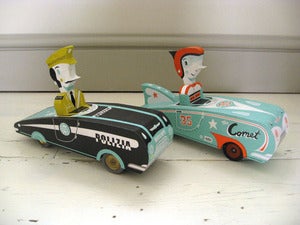
I have to say, some of my favourite pieces of work their were the stamps set by Tom Frost, and looking through some more of his work, I'm definitely a fan, so check out his blog to see what I'm on about, and I've also posted some pieces of his work that weren't at Pick Me Up below,... just because.


Dominic Owen


Tim McDonagh 


Peepshow Collective


Tom Frost's work...


The hand made, screen prinited toy and 3D work of some of the best things I've seen in a while....seriously want one of those cars!


Sunday, 15 April 2012

The Teenage Market

Recently a group of us uni students went down to 'The Teenage Market' in Stockport to sell prints, cards, jewellery, crafts, etc. that we'd made, to raise money to go to D&AD New Blood in June.


The market seemed pretty successful overall, with lots of people turning up and all sorts of stalls and performances happening. I wouldn't say we made that much money, but it was definitely worth going and seeing what we could sell. We sold more of the craft/handmade items than we did of the cards and prints, but i think with a bit more prep time we could have done better on that front, with maybe a wider range and less specific images. My own at least was probably too specific and not the sort of thing people would put on their wall perhaps. And the cards were mother's day cards. The market was on the 1st of April. Enough said.


Overall, the market was a good experience and definitely worth a shot to make some money for D&AD, which we did. It was also good research for if we ever go to any fairs or markets etc. to try and sell work in the future, as to what sort of things sell and which don't.

Sunday, 8 April 2012

Hayward Gallery - David Shrigley: Brain Activity

(images by linda nylind)

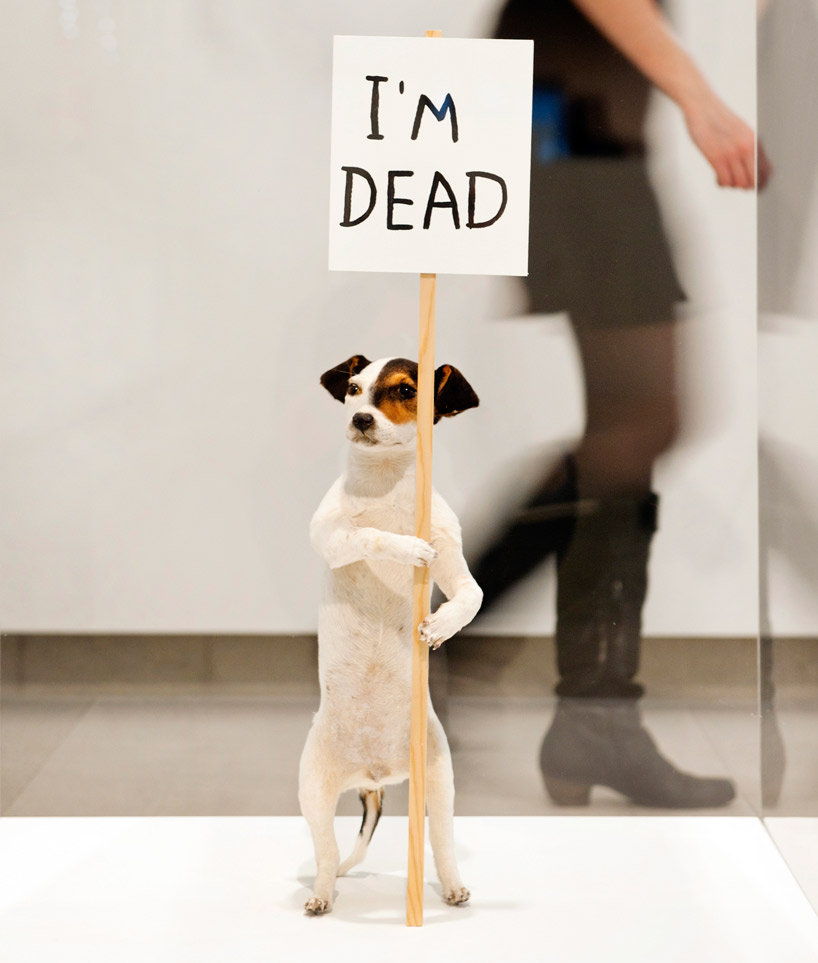
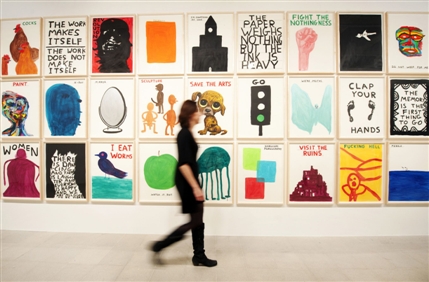
Whilst down in London we went to the David Shrigley exhibition at the Hayward gallery on the south bank. The exhibition was called 'Brain Activity' and was a mix of printed work, sculpture, and animation. It was a really fun exhibition to look round and there were lots of little things that could have easily been missed if you weren't looking carefully. For example their were some tiny little pictures near the floor you had to bend down to see, a peep hole in the wall, and a random stuffed rat just lying on the floor in the corner. 


I think my favourite parts of the exhibition were the prints that were up; one wall consisting of big posters (above) and another two walls of smaller doodles that were really funny observations or pictures of objects with a line of writing to explain them. It was just really interesting to look around and see the different things he'd made, and it had a great sense of humour. Not that often you find yourself laughing in an art gallery.

I've posted a video below of David Shrigley talking about the exhibition, so check it out...


Thursday, 29 March 2012

Serpent's Tail - London : Portfolio Visit #8


Last Friday a group of us went to visit Serpent's Tail publishing down in London. Serpent's Tail is an independent publishing house owned by Profile, and pride themselves on publishing daring and edgy books and, as they put it, 

"voices neglected by the mainstream, and still has a reputation for publishing
the best of all kinds of writing, from literary novels to
crime fiction, from work in translation to books on music and politics."

 When we were there we had a group meeting with Niamh Murray, the marketing director, who talked us through who Serpent's Tail were, what they did, and how they went about commissioning artwork for their books. She had a few examples which she talked us through, and explained how when they pitch cover ideas, its not just to the Serpent's Tail art director, but representatives from the big big shops, amazon and the supermarkets, who all have a say in the choice, based on their own needs. For example, as most books are seen as thumbnails on Amazon, they are usually looking for some bold, readable type, and the supermarkets are looking for a cover that will stand out amongst a lot of books, and appeal to a broad range of people etc.These were all interesting points that I didn't really consider before. She also spoke about how a different cover on the same book can really affect how it sells. I never really considered that the book cover would have such a strong affect on the sales of a book but it seems it really does, so getting the cover right is very important to them.

We then had the opportunity to individually show our work to the art director Peter Dyer. He went through my work quite quickly, and picked out the Stolen Peace album cover as the sort of thing that could work on a book cover. Overall he was pretty positive and mentioned sending through any new work I do that I think might be appropriate for them.

Overall, the visit to Serpent's Tail was really informative and gave me a much better understanding of how a publisher goes about sourcing and choosing work. Everyone there was really nice and seemed to have a genuine passion for finding good work and creating a great book cover.


Nobrow - London: Portfolio Visit #7

Illustration by Luke Pearson, from site here

Last week we went on a uni trip down to London for a couple of days, so we had the opportunity to meet with people in the industry to get some feedback on our portfolio's. Four of us took the opportunity to go and visit Nobrow at their shop in Shoreditch, where Sam Arthur spared some time to have a look at our work. Nobrow are renowned for their high quality self published books and magazines, more often than not featuring work by illustrators, both well established and new up and coming talent, and also sell a range of prints, tshirts, toys, etc.


When looking through my folio he mentioned which pieces he thought worked better than others, such as my 8x8 dinosaur-man piece, and ones that didn't work as well. He stressed to all of us the importance of having some consistency in your portfolio as it gives whoever's looking at your work a strong idea of what they will be getting if they hire you. He also mentioned to us all, that if we're showing our work to print-based art directors, to maybe not including installation or photographed 3D work as its not something they would be looking for. Perhaps tailoring your portfolio to who you will be showing it too is a good idea, which isn't really something I'd thought about before.

Another point he made was that it doesn't really matter how many pieces of work you have in your portfolio, and that it might be better to have fewer really good pieces of work that you love, rather than more pieces of varying quality.

Overall he gave us some good advice and some things for us to think about when we are trying to get work in the future, so it was a valuable visit! Thanks Sam!

Friday, 9 March 2012

From Student to Designer....

Yesterday, we had a day of talk on the subject of money, and how to make the transition from student to professional designer over the next few months. In the morning, two accountants came in and gave a presentation on how to setup our own business or become self employed, as well as paying taxes and book keeping, and other things like having a good business structure.

Later on, Ian gave a talk on being a freelance illustrator specifically, so this included info on working with art directors, copyright and licensing issues, fees, pro and cons of having an agent, etc.It was really good to get a basic knowledge of some of the stuff we should be aware of when we try and get commissions in the future, and how to deal with some of the legal issues that might arise.

He also spoke a little bit about self promotion and different ways of doing it, with mail outs, emails, phone calls etc., and of course online portfolio's. So on that note, here's mine . It needs some improvement but it'll suffice until I have time to sort it.

Finally, here is a link to an interesting article on pricing from illustrator/typographer Jessica Hische; definitely opens your eyes to the complexities of pricing your work....

Wednesday, 29 February 2012

Book Binding with Lucy Wilson

Last Tuesday, we were all treated to a book binding session with illustrator and book binder Lucy Wilson. It was a really interesting session and fun to learn how to make a book of our own. I'd never really thought much about making my own books or sketchbooks before, but it could definitely be an option for the future. Lucy told us about the advantages of an illustrator being to bind their own books, where to get book binding supplies from, and she had also used her book binding skills to make her own portfolio, which was really cool.

I've posted a couple of pics of the A5 book I made below. I think I probably need a little bit more practice at it as it seems I struggled to even fold my paper properly! But it came out better than I thought and after it was all sewn and glued it actually holds together pretty solidly. Thanks Lucy!