I did a few editorial illustrations in the not too distant past for the current issue of Managment Today magazine. I've post some pics of the images below along with the images themselves.
The first was a small illustration for a piece about transparency in businesses, so I did a glass suitcase exposing important things such as money, identity (passport) etc.
These next two are a full page and spot for a feature on 'mindfulness' and how it could improve your work life and therefore your business. These were originally going to have a 60's/70's theme to them which would have been a lot of fun to do, however the article got tailored back a little bit, but it was nevertheless a good experience and great to see in print!
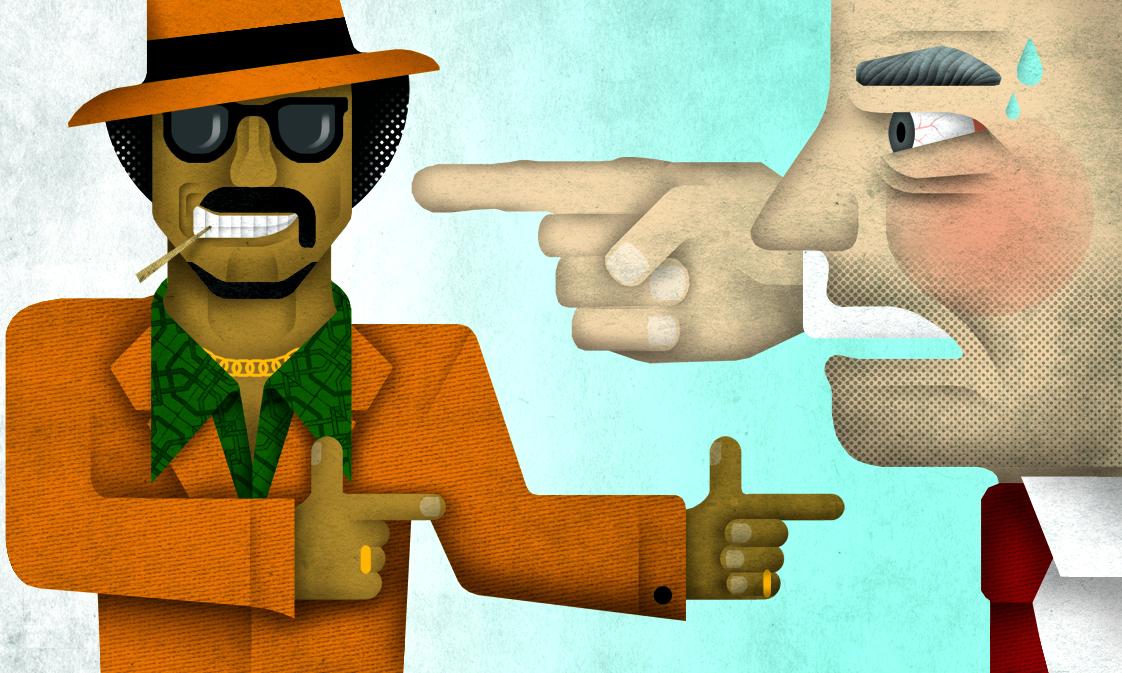
I recently did a small editorial illustration for this months issue of Management Today magazine. It was to illustrate the word 'Boss' from the given definitions. One definition of the word was that it was a synonym for 'superfly', hence the 70's guy on the left, and obviously a more standard office type boss getting a bit stressed on the right.
It was my first proper commission so it was a bit daunting, but it all went really smoothly and I'm fairly happy with the outcome. Check out the image below, as well as a snippet of it in the magazine layout. Cheers!
This article from a recent edition of Creative Review was recommended to us, and is written by Lawrence Zeegan, who has some interesting views on the state of the illustration industry at the moment, and compares illustration to current/recent London art exhibitions in order to make his point.
Zeegan is an 'educator, illustrator and writer' with over 20 years experience in the industry, so writes authoritatively, however the article seems to be a bit controversial with some people who read it. In the article, Zeegan describes illustration as being...
"Obsessed with its own craft, it has withdrawn from society's big debates to focus on the chit-chat of inner sanctum nothingness."
He compares the recent David Shrigley exhibition in London, with the Pick Me Up graphic arts fair across the river, both of which some of us visited when I was down in London.
He asks the question "Are we offered mere nothingness?" about the work at Pick Me Up. He makes the point throughout the article, about illustration reverting back to a "cottage industry" where illustrators are creating work that is in fashion and looks good, but with no real message or substance, and that the audience they are creating it for is mostly small and comprised of other illustrators. He writes about how illustration should aim to reach a wider audience and should be able to comment on the surround world in the way an 'artist' does. It comes across that he's frustrated that the industry he's, in part, involved in (he is an illustrator after all) is stepping backwards rather than forwards, and not taking the opportunity to really affect change or be used to create strong messages in the way perhaps graphic design does.
It seems as though he's just very keen to have illustration come to the fore, whether it be to spread a message or even just for the money. He acknowledges the pull for illustrators to make their own products; zines, prints, clothes etc. in the "make-do-and-mend economy", but asks what will it take for them to take the step to a bigger platform, and maybe being more business minded might be the way to landing bigger commissions in the industry.
To be honest, I thought this article was really interesting and made think about what illustrators could or should aim to achieve. I didn't find any of the things he was writing about particularly controversial myself, it seemed more like he was frustrated with seeing the same sort of superficial work being created in an introverted fashion, rather than seeing powerful illustration being used to spread a message or communicating with a wider audience, which it of course has the potential to do.
Obviously as a student I can't say I have much experience of the industry myself, and there's probably hundreds of illustrators out there making a huge positive change through their work, but I do think it's true that 'artists' or fine artists do get the majority of that limelight, its not often you see an illustrator on the news for a controversial piece of work for example. A lot people don't even know what illustration is when I tell them! Step out of your own world for a bit and you realise most people don't know what sort of work illustrators do a lot of the time.
Throughout the article Zeegan writes most of his comments as questions, suggesting he just wants people to think about the ideas he's talking about, such as style of substance, and questioning why you are creating work and who for. The main thing I got out of the article was to aim high. I think that it is something uni have tried to teach us too, I remember we were told to aim high when trying to get meetings with clients in London, but on the other hand we've also had projects on creating our own products and publications as another way of getting our work out there and making money. So I think aiming for the best of both worlds is probably the way to go....
Check out the article here, and there are also some interesting responses in the comment section too. Peace.
Whilst doing a bit of research and looking around for ideas for my personal project, I came across this really cool poster for a short film called 'Connected', made by Anders Baden Nielsen and Joaquim Marquès Nielsen from Barq studio in Denmark. I really love the old 60's/70's sci-fi poster feel of it; the strong illustration and use of limited colours, and the really nice use of customised type. Making the image of the people in just one colour (with various bits of shading) is something I don't think I would have thought of doing, but it works really well, especially as it helps emphasise the bright white tubes connecting the two figures. I really love these types of posters, and Joaquim Marquès Nielsen has posted a really excellent explanation of their working process from start to finish, over on his blog here. Definitely worth a read. I've posted said image below for you guys to get your peepers on, enjoy.
I just found a link to cool article on Digital Arts online, about some 3D book covers that have been made by Vintage Books, for some classic horror and science-fiction novels such as 'Planet of the Apes', 'Journey to the Centre of the Earth, and 'The Lost World'. They work by the viewer wearing some of the classic red/blue 3D glasses, and the covers then jump out at the viewer, adding a more interactive experience to buying or reading a book. It's interesting to see how 3D, an effect obviously popular in films, has been translated over to still imagery to try and draw in a wider audience in the midst of the 3D revolution. I think this is a really good idea, especially for children, and as it says in the article, the illustrations work well even without 3D glasses. It would be cool to try and do a project using this method in the future. Anyway, I've posted some of the books covers below along with their illustrators...if you've got some 3D glasses maybe try 'em out..do't know if it would work though......enjoy!
I found this really interesting piece on BaseKit, written by illustrator Asia Simpson some time last year. She writes about how the internet has changed the way illustrators find work, and the advantages and disadvantages of the involvement of the internet. Really interesting read. Check out the original here.
><><><><><><><><><
Illustration – easier to get work because of the web?
Illustration has had a resurgence in popularity over the last few years. Drawings and graphics can once again be found in advertising, magazines, web and even fashion! The times of lugging a heavy portfolio with all your most precious creations around are over. How the web has changed the world for Illustrators
For me at least, the most important factor the web plays in an illustrator’s career is the ease with which work can be displayed, distributed, updated and changed.
In the past when an illustration was drawn out for a particular brief, it would have to be completely re-drawn if the client had wanted even the slightest change, which was not only incredibly frustrating but also time-consuming.
Now, whether work is created digitally or otherwise, Photoshop or a similar programme can be used to quickly change and tweak an image in minutes, meaning the illustrator can be more productive.
Promoting your work on the web
Thanks to the web, illustrators can create self-promotion material and e-mail it to a thousand prospective clients at the click of a button. When it comes to their own portfolio, it’s easy and truly affordable to create a website. Sites like BaseKit allow illustrators, photographers and designers to build a website easily to get their work out to a worldwide audience and keep it updated.
The web also provides access to a community of illustrators where they can network, enter competitions and most importantly get inspiration to create new work. Unlike a personal website these sites display your work to a wider and more interested audience (even if if essentially composed of other illustrators.) Many art directors and possible clients can easily visit one of these sites to sample many different people’s work.
New trends in web design led to an increased need for illustration on the web. There appears to be an increased demand for illustrators to commission bespoke graphics as many demand that sought-after drawn style. Again there are a number of sites, such as http://www.freelanceuk.com/find-a-freelancer or http://www.freelancers.net/, where not only illustrators but also other creative’s can search through freelance projects and bid to hopefully win the contract. However, this could be seen as both good and bad for the industry.
There is also the option of selling your work to a site such as iStockPhoto. Creating enough popular images can add up to a nice amount of pocket money. However,the most popular images may not be the illustrator’s style, or fit an exciting brief, and there’s also the matter that once sold, you renounce all control to your work’s use.
Illustration agencies are also an other route to go for on the web. It’s easy to connect with anyone, anywhere in the world and have a good working relationship over long distances. Some even offer the option of creating a portfolio on their respective sites, which they can then show their clients.
A surge in online pdf magazines, such as, http://www.pdf-mags.com/ has created more opportunities for illustrators to create a portfolio of ‘published’ work. Those enable them to learn how to liaise with other professionals and get their work out to an already assembled audience. This represents a great opportunity for viewers to visit an illustrator’s portfolio site while consider linking their blog to the site. As a result, the illustrator will benefit from better SEO ranking and more chances for their personal portfolio to be found online by prospective clients.
On another note, the sheer volume and quality of tutorials available online help illustrators become aware of new trends, learn new skills and take their illustration abilities to another level.
In conclusion, the quality of work, despite being important, is not the main or only factor when it comes to finding work and getting commissioned. You could produce the best work in the world and no one is going to see it if it remains in your desk drawer or on your well-designed but obscure website. So my main point would be to encourage people to get their work seen by as many people as possible.
You are your own brand and make sure you enlarge and optimize your online presence through the aforementioned channels, as well as the social media ones, such as Twitter, Facebook and more… and hopefully commissions will follow!
This post was written by Asia Simpson Web Designer at BaseKit and freelance illustrator
Found this interesting article over at Computer Arts, where illustrators and designers give their thoughts on the change from analogue to digital in illustration, and their own experiences of it. Check it out below....
---------------------------------
Digital illustration
A revolution has taken place. The digital revolution has altered the nature of illustration beyond recognition – taking it from cottage industry to household phenomenon…
Things weren’t always this way. Before the digital revolution, life as an illustrator was fairly straightforward, or so it seemed – there was no Bill Gates, no Apple, no Photoshop, no Google, no internet, no email… no hassle. Looking back at life before the revolution, albeit through rose-tinted specs, the working day for your lone illustrator was a fairly simple affair. In fact, depending on just how far back you wish to peer, it’s clear to see just how much has changed. Back in the land-that-time-forgot, a common-or-garden commission for a freelance illustrator would come about with a phone call made by an art director to an illustrator’s land-line – mobiles only came into everyday use just over a decade ago. If you were out of the studio when the call came, chances are you could miss the job – answer phones even 15 years ago were not the norm. The brief itself would have to be posted or collected – fax machines were huge, cumbersome and expensive items even just a decade and a half ago. How the freelance illustrator, just ten years ago, maintained a professional profile, informed clients of new work and displayed their portfolios has altered beyond recognition. Without websites and email, illustrators would utilise the humble postcard as their calling card to the creative world, designing, printing, addressing and posting hundreds of these mailshots on a regular basis.
With just that single postcard to judge an illustrator’s capabilities by, art directors would take time out of their working day to view physical portfolios. Yes, they would actually look at real work in real time in the real world. Now, only six digits into the 21st century, those that commission illustration are able to view work in seconds, make creative decisions in minutes, have an illustrator briefed within hours and set the completion of the work with a deadline of a few days.
Gazing into the not-so-distant future back in 1992, John Warwicker, Creative Director of design collective Tomato, said without even a trace of irony: “I can envisage a time when we’ll all need our own individual Macs.” The working life, life-styles and the life-skills needed by today’s ‘creatives’ have altered, adjusted and accelerated. The digital revolution would take no prisoners – it was clear, adapt or die!
From analogue to digital
Jason Ford, Royal College of Art Class of 89 MA graduate and Association of Illustrators award-winning illustrator, entered the industry with a purely traditional skill-set. Ford recalls his own transition into the digital. “My work had always been about trying to achieve a flat graphic/silkscreen feel to it,” he explains. “I was trying to hide the brush-mark as much as I could.” Moving from brush and paint to screen and mouse wasn’t seamless though. “Numerous people kept telling me that I could achieve what I was doing with paint so much easier and much quicker using a computer, but of course I resisted this as long as possible,” Ford recalls. “For me, back then, the digital world was a void of incomprehensible gibberish!”
Also stepping out of the Royal College of Art at the fag end of the 80s was textiles designer turned collage-artist turned illustrator/designer Paul Burgess, best known at the time for his seminal book jackets for Vintage Books. “When computers came along in the mid 90s,” remembers Burgess, “we all hated them – we thought they were rubbish. However, we were all proved so wrong!”
Recognising that everything was about to change, Burgess set about embracing digital technology, but in his own punkinspired fashion. “I bought my first Mac and slowly started to get to grips with Photoshop, but trying to misuse it as much as possible,” he admits. It was clear that some of those to enter the digital domain would do so on their own terms.
Entry to the digital world came at a price, though. “My first Mac cost nearly £3,000, crazy when you think about it now, and it was so very slow,” offers Burgess. Buying and setting up a new Mac was just at the bottom of a new and radically steep learning curve – getting to grips with software, even if you could master the hardware, would be a challenge to those that have always worked manually. “I’m selftaught,” admits Burgess, “with loads of help from mates who have begrudgingly shown me tips and tricks along the way.”
Jason Ford confers with Burgess. “I’ve always had loads of help from studio buddies a lot further down the digital path than me,” he ventures. “It always helps to share studio space with designers who understand all the technical stuff and can help out when an image disappears from your screen for no reason at all!”
An education in illustration
For a younger generation of illustrators and image-makers, the digital revolution started to seep in during their time at art school. Lucy Vigrass, one of the original Peepshow crew, came out of the University of Brighton in 98. “I think we had a one-day session in Photoshop,” she recalls. “We all made pictures of ourselves looking like we had cling-film over our faces!” Keen to embrace new techniques and working methods, Vigrass learnt the hard way. “Most of my learning,” she recalls, “came from people around me and working things out for myself. I think that you pick things up out of necessity and keeping up with shortcut one-upmanship.”
Brett Ryder, emerging out of Central Saint Martins in the mid-90s, wasn’t equipped any more ably than Vigrass was at Brighton at the time. “I learnt to use the computer at home,” Ryder recalls. “The majority of people using the computer at college were the graphic design students so I didn’t get the help I needed.” As well as getting access to the right kind of teaching, just getting in front of the kit was problematic too. “Getting hold of a college computer was a miracle,” Ryder recalls. “I’m sure that they have a few more now…!”
Ryder’s work, now a unique blend of collage and hand- and digitally-rendered drawing and painting, wasn’t, by his own admission, at the time going anywhere. “I was unhappy about the direction my work was taking,” he admits. “I turned to the computer as I thought it could help solve the aesthetic problems I was encountering.” Ryder now works regularly for clients across the globe, recently for The New York Times, The Daily Telegraph, GQ magazine and O, The Oprah Magazine in the US, but his working methods have changed little in recent years. “It really is just the degree to which I draw or collage – my use of digital know-how fluctuates,” Ryder explains.
A decade after graduation from Kingston University in 96, John McFaul, no stranger to the pages of Computer Arts and Computer Arts Projects, can revisit his past with a sense of humour mixed with a touch of nostalgia. "I'm mainly self-taught,” he explains. “Graduating in the dark ages meant that computers were the tools ‘of the designers’ but because I’ve always been really influenced by design, far more so than illustration, it meant that these machines always held something of a distant intrigue,” he adds. Knowing just how far he has come since his early beginnings, McFaul muses on an early project: “I remember the first job I did using Photoshop – terrible! I barely knew how to use any of the tools and I was ringing my ‘designer’ friends every five minutes with questions.”
The digital generation
For those that have entered the creative industries - and more specifically the world of illustration, during the last five years or so – it would appear to them that everything has been digital for some considerable time. Advances in hardware and software have been almost immeasurable in recent years, and for a generation that has grown up with a PC in the bedroom, a mobile in their pocket and a playlist on their iPod, it is almost unthinkable that the technology has not been around for much over 15 years.
Steve Wilson, fresh from completing a unique event in the window of Oxford Street’s Selfridges store, recalls his first foray into the digital world fresh out of art school in 2001. “I was commissioned to create eight thumbnail size illustrations for The Guide, the mag given away with The Guardian on a Saturday, and they were reproduced over a period of four weeks,” he remembers. “I then didn’t get another commission for another nine months so I spent the £360, earned from The Guardian, many times over during that period,” he admits. “But since then I’ve worked for many clients including Virgin, Coca-Cola, MTV, Wallpaper and the BBC.”
Self-taught, he is still learning. “I think I’m still only using a fraction of the software’s capabilities,” he explains. Working predominantly in Illustrator and Photoshop, he gets what he needs out of them, but, he admits, “There are still plenty of tools and options that I barely use. Occasionally I’ll discover something new and within a few months I’m thinking ‘how on Earth did I live without that!’.”
“I consider myself part of the Digital Generation – we started making images using computers while at art school,” explains Mr Bingo from his East London studio. “I’ve always been working digitally in a professional sense but, of course, my induction was quite some time before.” Mr Bingo keenly recounts his proud past: “I was using Deluxe Paint III on the Commodore Amiga 500+ in the early 90s,” he states. “I was making animations that simulated a few seconds of a scrolling shoot-’em-up or the occasional flying penis, you know the kind of thing…” We do?
Emily Alston, another fully paid-up member of the digital generation and fresh out of Liverpool John Moores University just two years ago, explains that the culture of her degree course actively encouraged digital working methods. “We had masterclasses at university, but as I had never really bracketed myself as an illustrator, I would leave my easel behind and follow the graphic designers into the IT suite,” she explains.
Finding your own way
“When working digitally it’s really important to find your own way of working with the technology,” Alston advises. “Every illustrator and designer has the very same technology available to them, and if everyone uses the tools in the same way, nothing would ever stand out as different or original.”
Paul Burgess, a generation apart from Alston but in absolute agreement with her, states his case: “I think it is very difficult now. Everyone has a computer, everyone has the same software and everyone thinks that they can stick a couple of butterflies onto a twiddly background and ‘hey presto’ they have an illustration. You don’t have an illustration; you have decoration – there is a big difference!” Burgess, not shy of giving his opinions, continues: “Digital technology is very exciting, but only as exciting as the ideas you have inside your head.”
“As with most professions,” adds Jason Ford, drawing upon his extensive experience in the industry, “75 per cent of the illustration put out there is a dog’s dinner, but the other 25 per cent keeps the standards as high as they should be.” Steve Wilson is a little more positive, saying, “It is really all about trying to produce work that is distinctive and original, whatever that is, and work shouldn’t be judged on the levels of technology involved in making it.” Wilson has more to say on the subject: “I never understand people who are anti computers or pro computers. Who really cares how you get the results – it is only the final image that counts, regardless of how you got there.” Burgess, though, demands the final word: “The idea is king. Once you have a strong idea, everything else just flows along behind it.”